Different Energy Blasts and Powerful Mag: A Practical Guide to Visual Impact
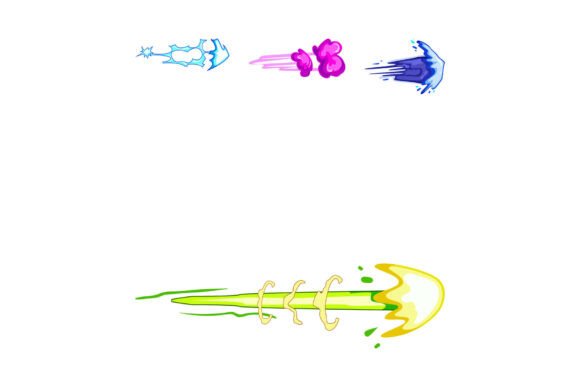
When integrating Different Energy Blasts and Powerful Mag assets into game design or animation projects, the immediate goal is often sheer spectacle. Creators want that satisfying, comic-book-style crunch or the ethereal glow of a high-tier spell. However, the difference between a professional visual effect and an amateur overlay usually lies in technical restraint and contextual understanding rather than raw particle count. These asset packs offer a vast assortment of diverse cartoon energy beams, element projectiles, and explosions, but utilizing them effectively requires moving beyond simple drag-and-drop implementation. Understanding the specific utility of these stylized effects ensures they enhance gameplay readability and narrative pacing rather than obscuring it.
The Readability Trap in Stylized VFX
One of the most frequent mistakes when working with cartoon-style energy beams is prioritizing aesthetic complexity over functional clarity. In a static portfolio render, a dense, multi-layered magical explosion looks incredible. In active gameplay or a fast-paced animation sequence, that same effect can become visual noise. When evaluating Different Energy Blasts and Powerful Mag libraries, beginners often select assets based on how "cool" they look in isolation. This leads to combat scenarios where players cannot distinguish between a healing aura and a damage-dealing fireball because both use similar silhouettes and saturation levels.
To avoid this, you must audit assets for shape language before importing them. Effective stylized VFX relies on distinct silhouettes. A projectile meant to indicate danger should have sharp, jagged edges and high-contrast colors, while supportive magic typically utilizes softer, circular forms. If an asset pack offers beautiful effects that all share the same amorphous blob shape, they will fail in a practical environment. Always test these assets against your actual background environments and character models, not just against a black void. An effect that pops on black might disappear entirely against a complex forest floor or urban setting.
Color Theory and Elemental Consistency
Another overlooked detail involves color grading and elemental coding. Many creators assume that because an asset is labeled "fire" or "ice," it will automatically fit their project’s art direction. However, stylized assets often come with baked-in lighting and specific color palettes that may clash with your scene's global illumination. Applying a neon-blue ice beam into a warm, desaturated post-apocalyptic world creates a jarring disconnect that breaks immersion.
Rather than forcing mismatched assets to work through heavy post-processing, which can degrade texture quality, look for packs that offer modular color variants or unlit textures. This allows you to tint the energy blasts to match your specific art bible. Furthermore, ensure you maintain consistent elemental coding across your entire project. If green always signifies poison in your game, do not use a green-tinted version of a "powerful mag" blast for a holy spell simply because the animation curve was better. Players and viewers rely on these subconscious color associations to process information quickly. Breaking this consistency forces the audience to relearn your visual language mid-experience, causing frustration.
Technical Integration and Performance Costs
Beyond aesthetics, technical missteps are the silent killers of VFX projects. A common misunderstanding regarding Different Energy Blasts and Powerful Mag collections is assuming that 2D sprite-based or stylized effects are inherently lightweight. While generally more performant than photorealistic volumetrics, poorly optimized cartoon beams can still tank frame rates if used indiscriminately. High-resolution flipbooks with excessive empty alpha space or unoptimized mesh counts add up quickly when multiple projectiles are on screen.
Before committing to a specific assortment of effects, check the technical specifications rigorously:
- Texture Atlasing: Are the frames packed efficiently, or is each frame a separate texture file? Atlased textures significantly reduce draw calls.
- Alpha Channel Usage: Inspect the transparency maps. Effects with tight alpha masking render faster than those with large areas of semi-transparent gradients that require expensive blending calculations.
- Looping vs. One-Shot: Verify whether beam effects are designed to tile seamlessly. Using a non-looping beam for a continuous charge-up attack results in visible popping artifacts that ruin the illusion of power.
- Shader Compatibility: Ensure the provided shaders work within your target engine’s rendering pipeline without requiring custom code rewrites that could break during future updates.
Neglecting these checks leads to optimization debt. You may find yourself months into production having to replace half your VFX library because the overdraw is causing mobile devices to overheat or consoles to drop frames during critical boss encounters. It is far more efficient to validate performance early than to retrofit optimization later.
Timing, Weight, and Animation Curves
Visual impact is not solely about what the effect looks like; it is about how it feels. A powerful magical blast needs appropriate anticipation and follow-through. A frequent error is using generic timing curves for specialized actions. A heavy, earth-shattering explosion should have a slower startup and a lingering dissipate phase, whereas a rapid-fire energy beam needs snappy, linear timing. Using a floaty, ethereal fade-out for a punchy kinetic impact makes the action feel weak and unresponsive.
When selecting from an assortment of diverse cartoon energy beams, pay close attention to the included animation curves or frame rate recommendations. Some assets are designed for 12fps stylized animation, while others expect smooth 60fps interpolation. Mixing these incorrectly results in jittery or unnaturally slow effects. If you are animating manually, treat the VFX as a character with its own weight. Adjust the playback speed and scaling curves to match the specific action triggering the effect. A "powerful mag" cast by a small fairy should feel different than the same spell cast by a giant ogre, even if using the same base asset. Scale and timing adjustments are free ways to maximize the versatility of your library without purchasing additional content.
Evaluating Quality Before Acquisition
Whether you are downloading free resources or investing in premium packs, due diligence prevents buyer’s remorse. Marketing renders for Different Energy Blasts and Powerful Mag are often composited with color correction, bloom, and motion blur that are not present in the raw files. To make an informed decision, always seek out raw previews or unedited gameplay footage. Look for edge quality on the sprites; jagged or aliased edges indicate poor resolution or bad resizing. Check for consistent style across the entire pack; some assortments are cobbled together from different artists, resulting in a disjointed visual experience where line weights and shading techniques vary wildly between assets.
Additionally, consider the licensing and modularity. For entrepreneurs and small studios, ensuring you have full commercial rights is non-negotiable. Beyond legalities, assess how easily the effects can be modified. Can you separate the core beam from the outer glow? Can you swap the spark particles? Modular assets provide exponentially more value than flat, pre-rendered videos because they allow you to create custom variations that fit your unique IP. Investing slightly more time or budget upfront for flexible, well-documented assets pays dividends throughout the production cycle, saving countless hours of troubleshooting and replacement.
Ultimately, successful implementation of stylized VFX is a balance of artistic intent and technical discipline. By focusing on readability, respecting performance budgets, maintaining stylistic consistency, and validating assets before adoption, you transform a simple collection of cartoons into a cohesive, impactful visual language that serves your project’s broader goals.